I’m not sure if anyone else questions what our role is here on planet Earth but I do! Every single species, whether it be an earthworm or a blue whale, and everything in between, all are in synch with mother Earth and contribute in one way or another.
Us? We can’t be tamed! Our biography isn’t a tale for the faint-hearted defining exactly what we are. We are a top predator, and deadly to all that stand in our way. And it has always come with a clear conscience. Not surprisingly our arrogance has led us to believe we’re running the whole show, living on our world of terra firma, forgetting it covers only 29% of the planet’s surface, while another world, far larger than ours is disregarded.
The oceans are where all life began and they are Mother Earth’s engine room, covering 71% of the planet’s surface, dictating the well-being of all that exists, and of utmost importance, regulating the climate. They’re tireless contributors, currently storing up to roughly 40,000 billion tonnes of greenhouse gases, while absorbing 93% of emissions and 90% of the planet’s excess heat from the atmosphere every day. They generate 50% of the world’s oxygen supply, which wouldn’t be possible without the assistance of the coral reefs.
These hotspots of marine life cover less than 1% of the planet’s surface, giving back more than their fair share. And what a mighty job they do, protecting the coastline from storms and serving as a nursery ground and home to 25% of the planet’s marine life, making their contribution crucial. So, it’s deeply disturbing to learn these forests of the ocean are under attack for the fourth time since 2020. This may be their last battle.
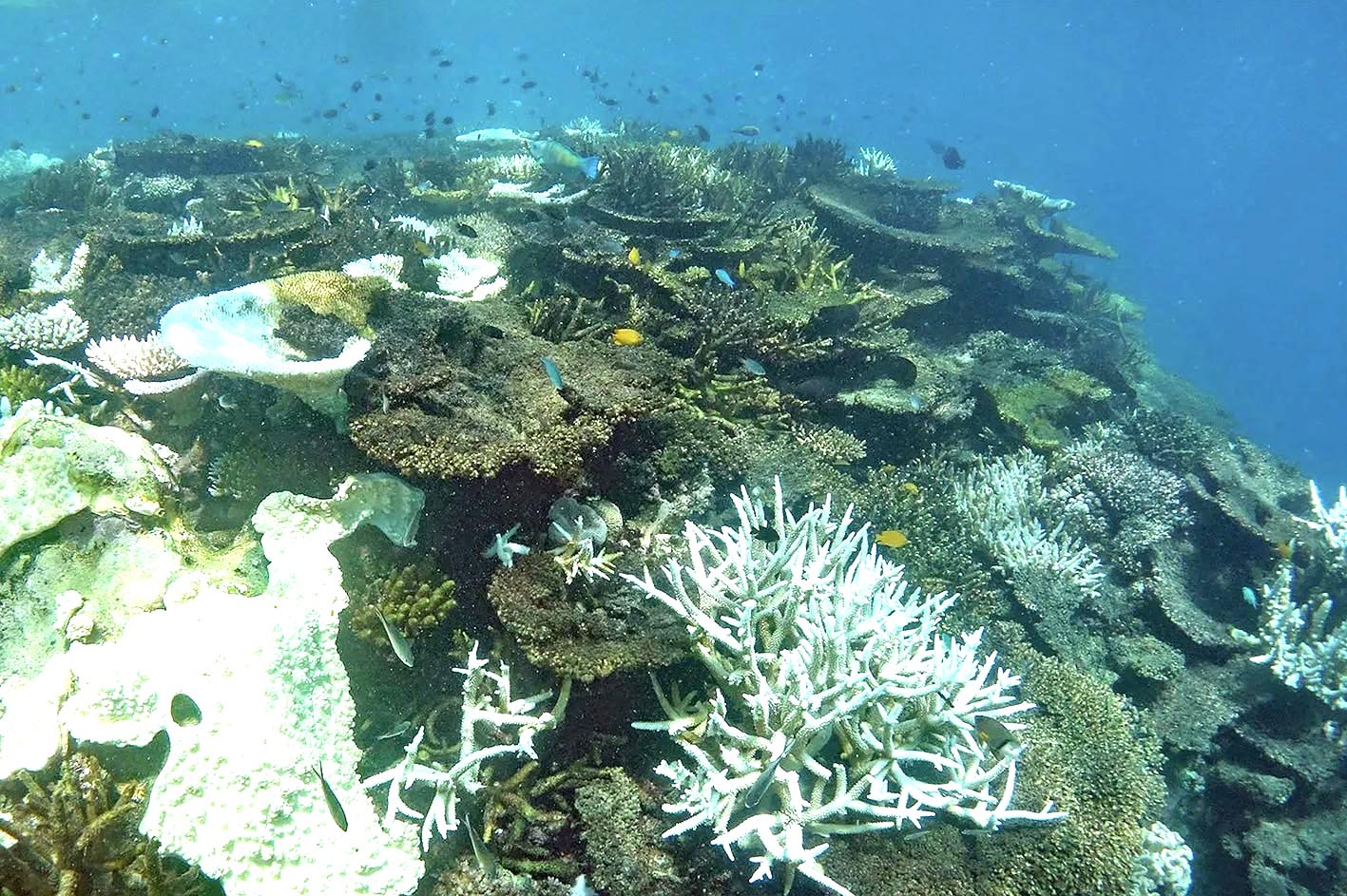
Before the 1990s, mass bleaching was extremely rare. Not anymore. According to the Global Coral Reef Monitoring Network, 84% of the planet’s coral reefs are dying, caused by rising sea temperatures and acidification, that ultimately leads to bleaching.
Coral cannot survive without their companion, a symbiotic alga (zooxanthellae), the very thing that gives them their vibrant colours. So, when the sea surface temperature rises, coral expel the algae and begin to starve. The survival rate depends on the species of coral but those that do manage to recover are left less resilient, leaving them more prone to disease and may not reproduce for another one to two years.
In Southeast Asia, a staggering 95% of coral reefs are under threat and in the Caribbean 80% are already dead and buried. In the Indian Ocean the devastation is widespread, stretching as far as Tanzania, Kenya, Mauritius, The Seychelles and the west coast of Indonesia. South Pacific island nations aren’t immune, including Fiji, Vanuatu, Tuvalu, French Polynesia and Kiribati, where 80% of the coral has vanished.
Closer to home is the Coral Triangle, situated in the Western Pacific Ocean, covering a vast area and a global epicentre of marine biodiversity known as ‘the Amazon of the seas’, surrounding the waters around Indonesia, Malaysia, the Philippines, Papua New Guinea, the Solomon Islands and Timor Leste.
It’s a treasure chest that’s home to 76% of the planet’s coral species and 37% of reef fish. The biggest jewel of all, is our very own Great Barrier Reef found in the aptly named Coral Sea, ranging in age from 8,000 to 9,500 years old.
In the last 25 years, 50 per cent of the coral in the Great Barrier Reef has died and there’s no improvement in sight after several consecutive years of bleaching. The destruction is widespread, including large stretches of the coastline from Townsville to Cape York, covering more than 1,300 kilometres and it’s a reoccurring problem. Last August, Lizard Island suffered the most, with up to 70% of the coral now dead. This is the severest and largest coral fatality ever recorded on the planet and the prognosis doesn’t look promising, when the frequency of these events leaves little time for recovery and over time will inevitably affect the health of the entire ecosystem.
In our world, the economy is the engine room, where we put a price on everything, but we foolishly forget to put a price on nature. In the words of environmental accounts, “natural resources underpin the global economy, from pollinators supporting agricultural supply chains, to forests ensuring water quality and availability.” Lisa Mandle,an ecologist at Stanford University puts it very bluntly, “if there were no nature, there would be no economy.”
Global warming has been a work in progress, unhindered for decades, and the unbearable weight of our inaction is pushing the oceans to an inescapable point of no return, fast tracking global warming in the process.
Last October, for the first time in recorded history, mosquitoes were found in Iceland. Is there any need to say more? They say seeing is believing, but how much more do we need to see? There are those still biding their time sitting on fences, others hiding down rabbit holes and many who think the planet will just bounce back like a rubber ball.
I’ve searched high and low long enough to know with absolute certainty that we don’t belong here! There’s nothing remotely natural about our sleek, self-made world, that serves us and only us, founded on slaughtering and evicting nature at every turn. This isn’t madness, this is suicidal!