There is no doubt that if Australia honoured its commitment to 30by30 it would stop the logging of all public native forests in north-east NSW and add them to national parks.
The logging industry recognises this. Regrettably the Governments don’t intend to honour this commitment, unless the community convinces them.
In 2022 Australia signed onto the Global Biodiversity Framework, committing to protect or conserve 30% of our land and seas by 2030, prioritising areas of high biodiversity value, adequately sampling the full range of existing ecosystems, and creating well connected networks of reserves.
The primary intent of 30by30 is to protect areas of particular importance for biodiversity. This requires protecting forests, as they support the majority of Australia’s exceptional biodiversity. This is particularly so for north-east NSW’s world heritage value forests that are internationally and nationally recognised biodiversity hotspots due to their exceptional numbers of endemic species.
These forests are refuges for lineages dating back over 70 million years that have withstood dramatic climate upheavals, due to more reliable coastal rainfalls and the variety of niches provided by the rugged topography of the Great Dividing and associated ranges. The rugged ranges have also provided a refuge from recent clearing.
They have the best prospects of maximising the retention of our declining biodiversity into the increasingly perilous climate-challenged future, provided we stop degrading them, allow them to recover their natural resilience, and restore their connectivity to allow species to track changing climates.
As the forests recover so too will the resources provided for fauna by old trees, such as hollows and nectar. The recovering forests will also benefit us, by reclaiming their depleted carbon from the atmosphere and storing it out of harm’s way, decreasing the risk of wildfires, increasing stream-flows, and reducing flood peaks.
Our national reserve system comprises 25% of Australia, though it is mostly deserts with relatively low biodiversity that will suffer some of the most extreme impacts from climate heating. An additional 39 million hectares still needs to be protected to reach 30by30.
NSW has one of the worst reserve systems, with less than 10% protected. The addition of the Great Koala National Park increases reserves to 21.5% of north-east NSW, north from Newcastle. Protection of the other 579,000 ha of native State Forests in north-east NSW will increase overall reservation to 29.1%. Still low for one of the world’s biodiversity hotspots.
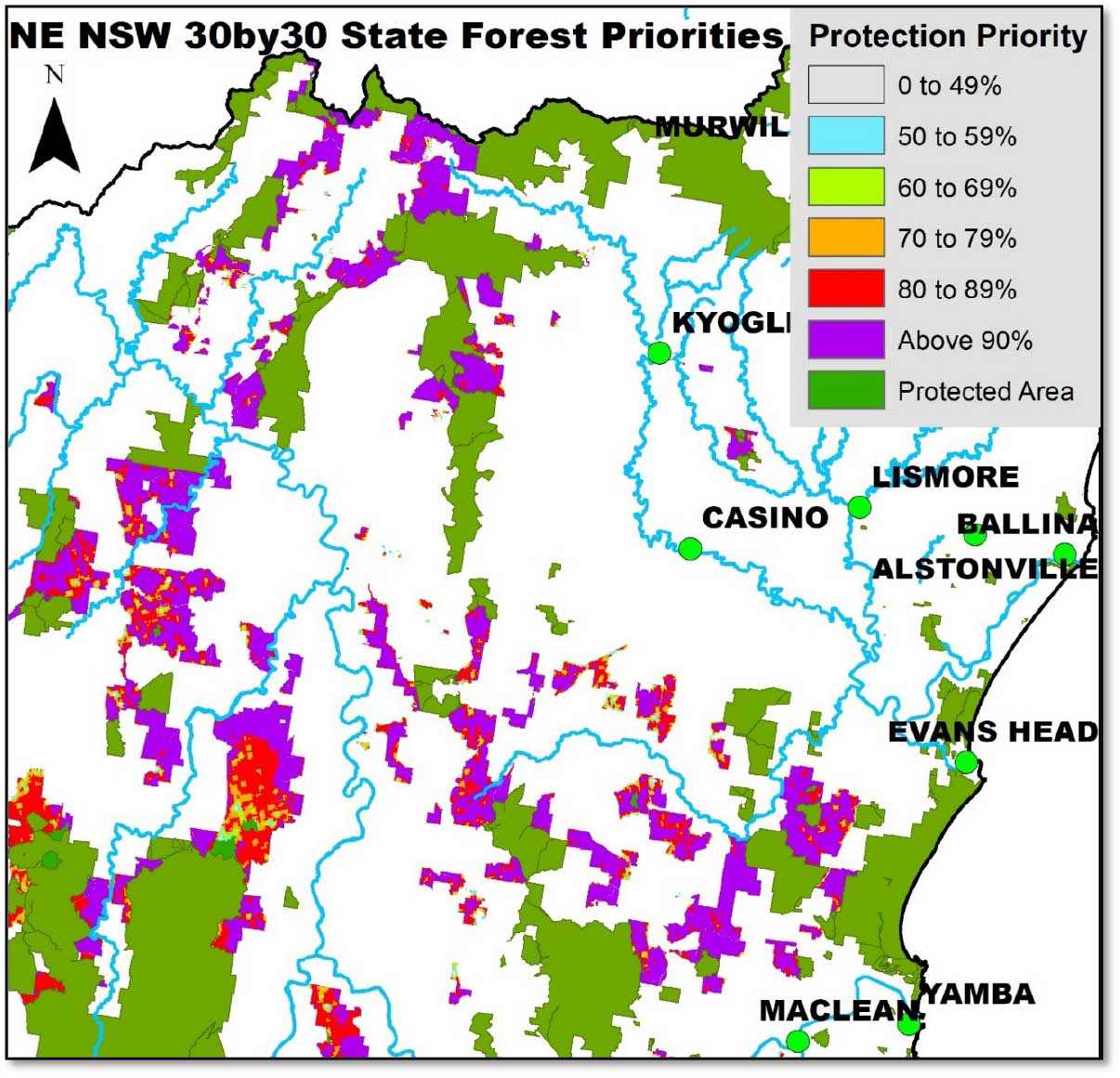
In January the Commonwealth released maps that applied the 30by30 criteria to identify areas known to have important biodiversity and ecosystem values that are not well represented in Australia’s existing protected areas. State Forests in north-east NSW are shown as the highest national priorities. Yet the 2026 Implementation Plan makes no mention of State forests, even though as public land they can be readily protected.
The 2025-26 Commonwealth Budget included a 5-year $250 million Australian Bushland Program to support achievement of the 30by30 land target. NSW has announced a joint $115 million package aimed at protecting 175,000 ha of private land over five years. Neither government has any intent of protecting all State forests, even though they already own the land.
The Global Biodiversity Framework also requires the Governments to reduce biodiversity loss, restore 30% of degraded ecosystems, halt species extinction and minimise the impacts of climate change on biodiversity. There is no better way of achieving these than protecting and rehabilitating forests.
Our public forests need your help. Please email or phone Prime Minister Anthony Albanese and Premier Chris Minns, as well as your local members, and ask them why they refuse to protect all State Forests in north-east NSW given that Australian Governments have identified them as the highest national priority for 30by30 because of their outstanding biodiversity.
Caption: Detail of the Commonwealth’s recent mapping of identified areas known to have important biodiversity and ecosystem values that are not well represented in Australia’s existing protected areas, trimmed to native State Forests, showing them to be amongst the highest national priorities for 30by30.