
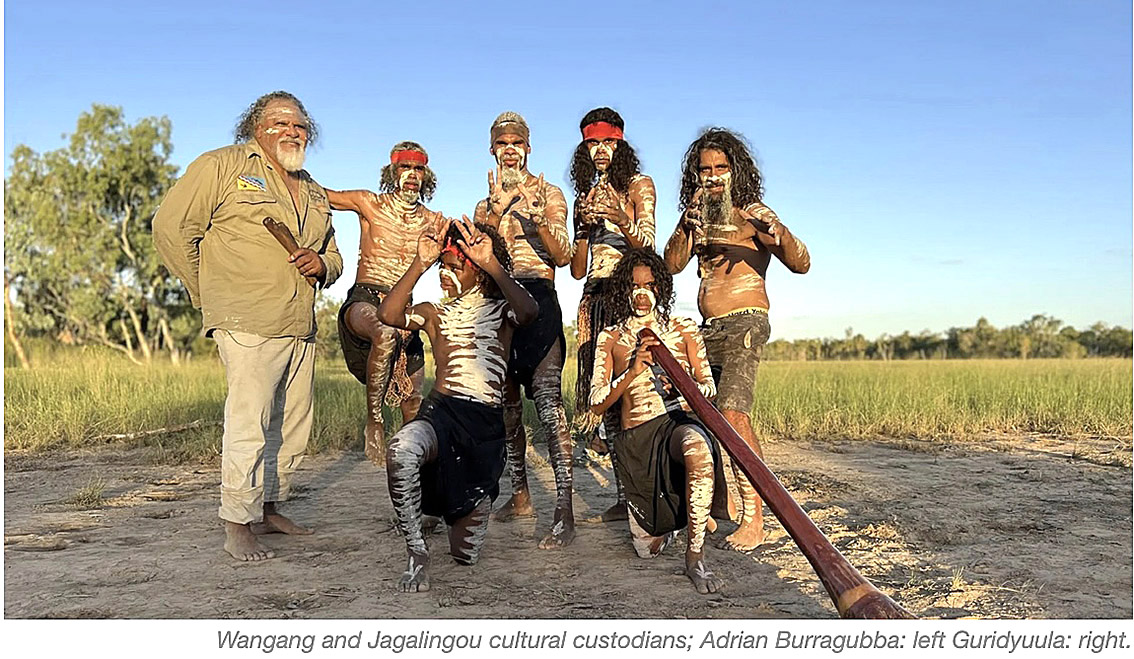
Adrian Burragubba, a Wangan and Jagalingou (W&J) elder visited Brunswick Picture House recently to provide an update on their long running campaign to protect their lands and sacred Doongmabulla Springs in the Galilee basin impacted by Adani’s open-cut coal mine.
Adani’s contentious project was initially approved by the Federal Environment Minister in 2014. The Stop Adani direct-action campaign lobbied local and international banks and insurers targeting 145 companies to discourage involvement in the project.
Conservation groups instigated court actions objecting to impacts on the environment and biodiversity, water usage and carbon emissions.
Permits allowing new port facilities including sea-bed dredging at Abbot Point and dumping of spoil in Caley Valley wetlands were challenged in three separate court actions.
The Tribunal withdrew the permits after Federal legislation banned dumping within the Great Barrier Reef Marine Park in June 2015.
Objections to using public funds to bankroll infrastructure led to the proposed new rail line being abandoned. A 200km extension to the existing narrow-gauge railway was completed in 2021.
A new airport for fly in/fly out workers became an upgrade of an existing airfield on a nearby property.
Funding difficulties and court action resulted in delays and downsizing from 60 million tonnes of coal per year to 10 million. The lifespan was reduced from 90 to 60 years with estimates of 200 million tonnes of carbon dioxide to be generated over the timeframe.
Work commenced in 2019 and the mine has been operating since 2021.
W&J rejected the Indigenous Land Use agreement (ILUA) presented by Adani in October 2014 claiming it would destroy their ancestral lands and cultural heritage.
A ‘Defence of Country Declaration’ presented to the Queensland021 parliament claiming their rights under the UN Declaration on the Rights of Indigenous People were not being recognised or enforced fell on deaf ears.
In 2016 the Qld Native Title Tribunal overrode the objections of traditional owners and granted two mining licences to Adani on the basis the project is in the public interest.
Adrian Burragubba lodged W&J’s appeal against the Tribunal decision but in August 2016 the Federal Court dismissed the challenge.
The community split over the ILUA offered by Adani in 2017 with 7 of 12 representatives accepting the take it or get nothing deal.
An appeal by the five dissenting reps was dismissed by the Federal Court with Adani seeking $680,000 in court costs, bankrupting Adrian Burragubba who led the action.
In August 2019 the Qld Government intervened and extinguished native title over 1,385 hectares of W&J country including their camping area used for cultural ceremonies, granting Adani exclusive freehold title.
The mining company took action in the Qld Supreme Court to have the W&J campers charged with trespass and a restraining order was issued so they couldn’t return.
When the Burragubba family returned to conduct ceremonies the police were called and forcibly removed them from their land.
Disgruntled traditional owner groups united under the Clermont-Belyando Native Title Claim.
In 2021, after 17 years of legal wrangling the Federal Court dismissed their claim, removing their right to consultation or compensation in future mines after concluding they did not establish sufficient legal connection to their land under the Native Title Act.
W&J turned to the new Queensland Human Rights Commission. Section 28 of the Qld Human Rights Act (HRA) adopted in 2019 recognises the distinct cultural rights of Aboriginal & Torres Strait Islander people and their special connection to land and sea.
Action resulted in the Qld police issuing a letter of regret for evicting the Burragubba family – a first for police!
In April 2023, the Qld Environment Department received advice from CSIRO and Geoscience Australia which identified “several major issues” with Adani’s groundwater modelling and the threat of “environmental harm” to the Doongmabulla Springs.
In Feb 2024 W&J pursued a judicial review in Qld Supreme Court seeking an injunction to stop mining and provide “scientific certainty’ the Springs were not under threat.
In January 2026 the full bench of the Queensland Court of Appeal ruled in favour of the cultural custodians.
The court held that the refusal to issue an Environmental Protection Order can affect Aboriginal cultural rights and that inaction can affect the practical enjoyment of cultural rights.
The decision doesn’t stop mining near the Springs, but it clears a pathway to trial. It’s a significant breakthrough and confirms Aboriginal cultural rights are enforceable under Qld law.
The Queensland Government didn’t appeal the decision. Its role in providing scientific certainty and protection of sacred springs will proceed to trial in the Supreme Court. A trial date is yet to be set.
Challenging and defending Adani’s project has cost the community millions of dollars, while the profits for Australia are minimal and the risks for the Galilee Basin remain unacceptable.
A review of the public interest is long overdue.