
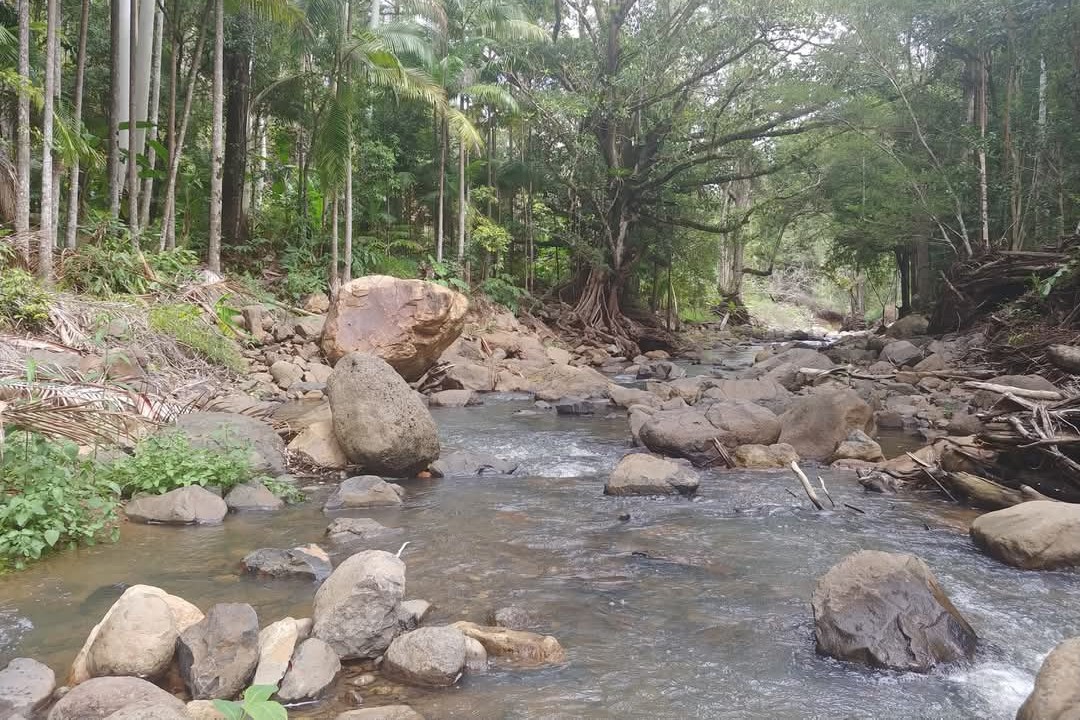
This is the objective of the Nimbin Water Collective: that the natural flow of the springs, creeks and rivers continues in a healthier and vibrant manner is the life-blood of our region and communities.
Indeed, following the months of steady soaking, the water table is high and surface waters saturate the landscape.
By contrast, when the sun is out it is hot and the evaporation rates in the coming months likely to be high – a condition we have been seeing for some years now.
In times of great change, core stability is key to weathering unforeseen events and giving rise to the possibility of being able to adapt to the changes as they occur.
Within the complexity of water flow, core stability lies in retaining the hydrological integrity of those processes upon which the system depends.
That is, maintaining water levels within artesian aquifers and the pressure within those confined systems which forces water to the surface.
The higher basins are reliably recharged by rainfall, but the deeper underlying sub-aquifers, such as the Clarence-Moreton Basin (CMB) beneath us, is described as a geological reservoir potentially resultant of meteoric and plutonic processes from whence the pressure is derived.
All these elements are vastly understudied within the CMB with little real knowledge readily available to define potential impacts on the overall system. This is a major concern for the groundwater-dependent ecosystems such as is Nimbin.
Hence, the 220 metre bore into the CMB on the Alstonville Plateau to supplement Rous County Council’s (RCC) bulk water supply requires further investigation.
At this point within our circumstances here in Nimbin it is important that all people are aware and pro-active in relation to protecting the region’s waters and where conscious and environmentally sound land management is a high priority.
In the past months we have seen:
1) A Resolution passed by Lismore City Council (LCC) to seek confirmation of availability of water from RCC’s bulk water supply, which would potentially be piped via The Channon to Nimbin. Most Councillors agreed to this Resolution without having viewed the Options Assessment on the water provision for Nimbin.
Part 2 of this same Resolution was that should RCC consider water provision to Nimbin as viable, then LCC would go ahead to seek funding for the project. No public consultation on this matter has occurred with the people of Nimbin.
2) LCC has completed the public submission phase to its Draft Strategic Plan (60,000 project). This project aims to incorporate a further 14,000 people into the Lismore LGA, with many of the proposed developments being expansions of the small villages of the LGA and some expansions of urban Lismore.
Many of these prospective developments have not yet been assessed for either extension of their current water supplies or potential provision from the bulk water supply. Nimbin is not currently included, as there remains a moratorium on new developments in Nimbin which would require reticulated water.
3) The CSIRO recommendations regarding catchment flood mitigation measures have brought forward highly contentious strategies, involving incursions into the land with knowingly minimal improvements to conditions of a high-volume flood event.
4) It has become known that the NSW government’s amended environmental legislation will also now be underpinned by new regulations within the Dept of Planning that impact on the responsibilities of all government agencies (including Councils) to act with regard to public consultaion. We have been told that these draft measures are yet to be finalised and implemented.
The Water Collective is at this time seeking to gain further insight into the range of matters that potentially impact our regional waters.
We continue to advocate for the wholistic and environmentally sound strategies that many groups within the region continue to work on nature-based solutions.
Cessation of logging and land-clearing in the catchments; revegetation of critical and riparian zones within the catchments; purification strategies for the river systems; water recycling and re-use measures for outdoor use including roadworks, farm supplementation and firefighting.
Also in times of great change, the core stability of people and communities lies in co-operation and input of energy towards those clearly defined initiatives that will, in the long-run, determine how we will weather the future together.
Anybody wishing to contribute energy to the Nimbin Water Collective please make contact by leaving a message at the Environment Centre or via: nimbinenvironmentcentre@gmail.com
Related story: ‘Mega droughts and mega floods need mega solutions’ on page 5.