
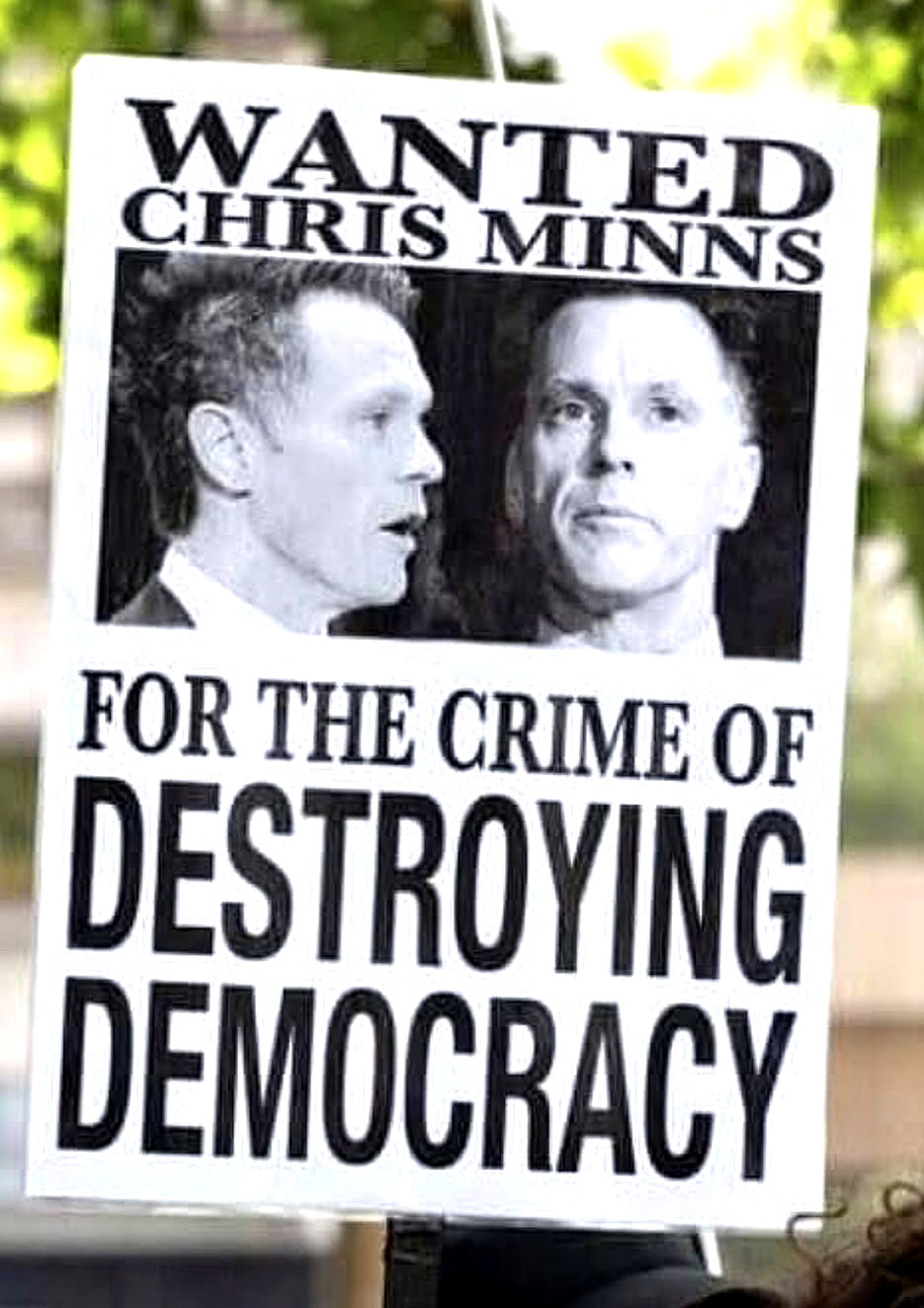
The sins of Minns, where to start? It’s going to require at least three volumes to even scratch the surface.
My misgivings about Chris Minns began before the last state election. Former Premier Perotet was a deep conservative, and I just could never vote for the LNP.
But somehow despite that, he appeared to be a human with a sense of conviction, a moral compass and some personal integrity. Regardless of party affiliations, I like to give credit where it is due.
Perotet was proposing some small but meaningful poker machine reforms and Chris Minns was pandering to the pokies lobby as usual and offering spin and inaction. I could see the Labor hollow man on the horizon, but I had no idea how bad it really would be.
Add to that, not preferencing Minns at that time would have meant not preferencing Janelle locally and that risked whatever stooge the local Nationals were offering up as local member, so I dutifully preferenced Labor, but with some misgivings.
Fast-forward just over three years and I can safely say Chris Minns is the worst NSW premier in living memory from any party.
There’s been incompetence and there’s been corruption in the past, but Minns is the nastiest, most authoritarian, disingenuous, anti-democratic, divisive, ruthless, blight upon the state and upon the long Labor tradition in this country that I can recall.
He is so extreme right-leaning that even Albo must detest him. Minns actively joined the cheer squad against Albo after the Bondi tragedy, and he even attacked Albo for doing one of the most Labor things of his term by ending the housing investor rorts. Minns is absolute poison not just to NSW, not just to democracy but to his own party as well.
So I shall begin a three-part series on the sins of Minns.
Minns, the enemy of democracy
I am not always sure Chris Minns has any political agency. He really appears to just respond to whichever powerful lobby is pulling his strings. One day it’s the timber or coal industry. The next its the gambling or alcohol lobby and otherwise its perpetually his patronage to a certain almost legally unmentionable nation state in the Middle East that he wants to legislate against us being able to criticise.
But where he really seems to come into his own is in his extreme dislike of free expression, protest and anything outside the majoritarian party system that has handed him power.
In less than one term he has driven an anti-protest agenda that is truly alarming.
The Australian Constitution is very weak on protecting civil and political rights, the latitude for our parliaments to enact laws that restrict association, expression and association are very wide (just look at some of the Federal anti-terror laws we have).
Nonetheless our High Court has found that our Constitution implies a freedom of political communication as an essential component of a representative democracy. Not once but twice Minns has enacted anti-protest laws that the Courts have found to be unconstitutional.
Terrorism (Police Powers) Act 2002 (NSW) – Part 2, Division 3A (Public Assembly Restriction Declaration laws introduced following the Bondi Beach terrorist attack) was declared invalid on 16th April 2026, after a challenge by the Palestine Action Group.
Law Enforcement (Powers and Responsibilities) Act 2002 (NSW) – Section 200(5), along with related move-on and public assembly provisions used to restrict demonstrations and public gatherings, was also declared invalid by the court in a case brought by climate activists and those dangerous radicals, the Knitting Nannas.
That’s right, the same Premier who divisively projected a foreign country’s flag onto the Opera house also tried to pass laws to stop people publicly criticising that country for allegations of genocide.
After the Supreme Court struck out his legislation, Minns didn’t apologise for breaching constitutional protections of democracy, he instead doubled down and criticised the Judiciary.
He has also proposed laws similar to Qld laws banning pro-Palestinian phrases, laws which are also headed for a likely successful constitutional challenge.
Minns’ clear determination to prevent any form of protest that he disagrees with has not only included attempts to stifle criticisms of the state that must not be criticised, it has included attempts to stifle peaceful climate activism as well.
But of course, it doesn’t end there. Following the gratuitously violent police actions during the Sydney Town Hall protests against the visit by the Israeli president, Minns and his ministers have doubled down in refusing the Courts to have access to documents such as police body-worn camera footage and details of communications between himself, his ministers and senior police that led to the unlawful and violent police actions of that day.
Thankfully once again, the Judiciary is a bulwark against extreme totalitarianism under our constitutional system, and finally lawyers for the victims (the bashed peaceful protesters) have recently succeeded in getting a court order to force Minns and his ministers to cough up the evidence they have been hiding from judicial scrutiny.
This form of totalitarianism goes beyond ordinary politics. If a Premier is repeatedly clashing with the judiciary over his own government’s illegal actions and constitutional violations, there is a serious problem.
His extreme opposition to protest, to free expression and to police accountability is on-going. But again it doesn’t end there.
The relationship between the Minns government and senior NSW police is a cause for real concern. The constant increase of police powers, the on-going enthusiasm for deeper and deeper forms of electronic surveillance, and a repeated resistance to allowing the appropriate bodies that are responsible for oversight of police misconduct to have access to the information required to perform their functions is dangerous.
Not only does his government resist judicial access to information required for proper police accountability, his government also continues to deprive the Law Enforcement Conduct Commission (LECC) , the very body tasked with oversight of police misconduct from having access to vital sources of information.
• The Minns government has rejected calls to give the LECC a straightforward statutory right to demand and receive all crucial NSW Police documents and records automatically.
• NSW Police are currently able to withhold legal advice and rely on existing legislative boundaries to delay or deny handing over certain files to LECC investigators.
• Existing rules allow police to de-identify officers who are accused of serious misconduct during certain internal reviews.
Because the LECC lacks these broader direct enforcement powers for certain documents, it is frequently forced to appeal or take matters to the Supreme Court to gain access. So running protection for police misconduct appears to be the official NSW government policy position.
While the Police watchdog remains hamstrung, the Minns government has introduced new state surveillance powers, digital and mobile phone evidence access, and facial recognition/driver licence sharing powers for police while declining to extend matching investigative or transparency powers to the LECC.
The Minns government is far worse than I anticipated when I reluctantly scribbled a Labor second preference last state election.
Some issues go well beyond party political loyalties. The sins of Minns at least include the following:
• Hostility to established democratic norms
• Legislative non-compliance with the Australian Constitution
• Disrespect for the role of the Judiciary in maintaining civil rights
• Refusal to support proper processes for oversight of police misconduct, and a general hostility to proper accountability.
There are going to be two more parts to this series on the sins of Minns, but this is enough for this month.