
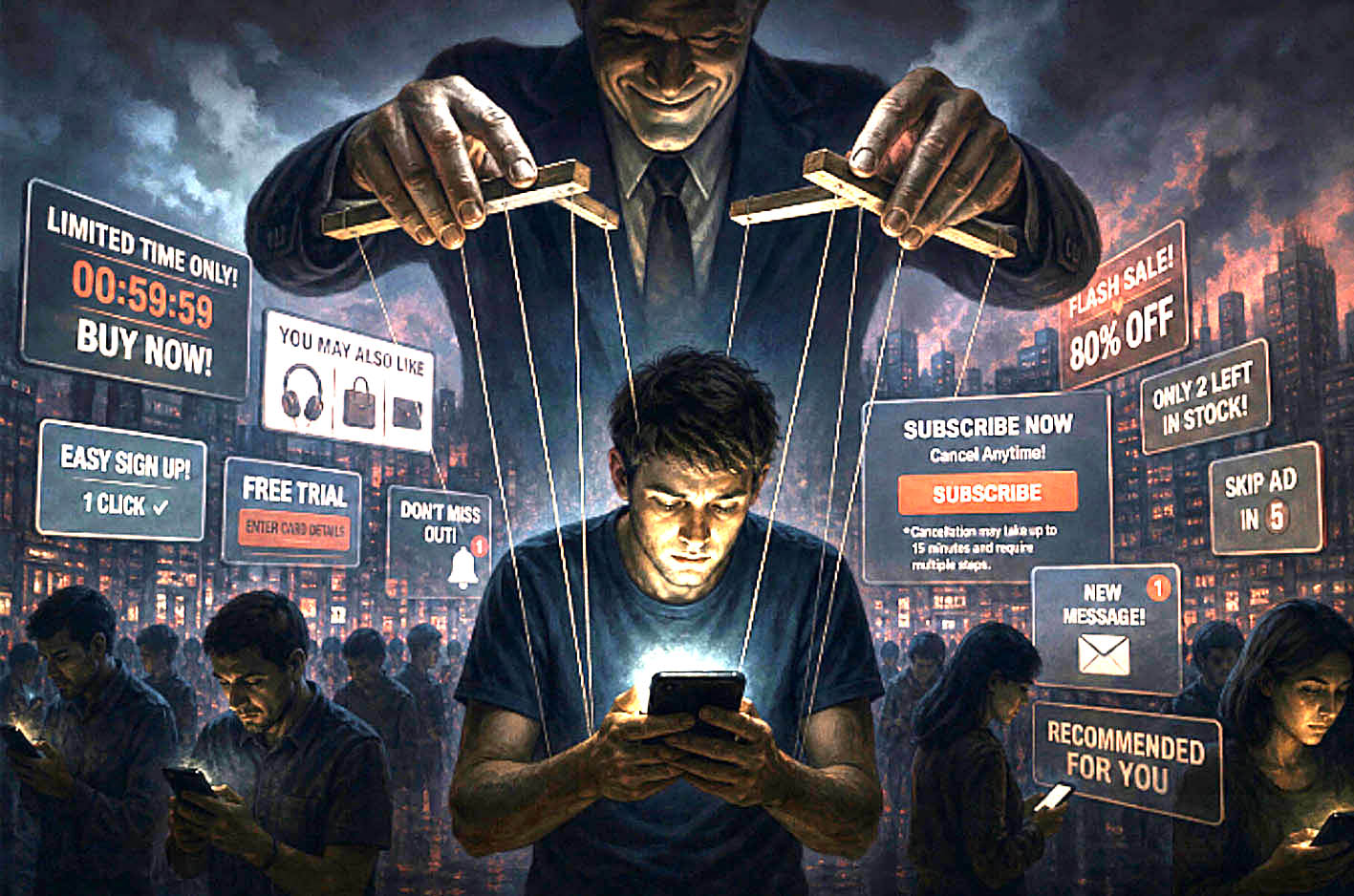
Modern marketing and technology companies have developed increasingly sophisticated methods to influence consumer behaviour.
While advertising has always attempted to persuade people to buy products, digital technologies now allow corporations to shape attention, habits, emotions, and decisions with unprecedented precision.
Through manipulative interface design, psychological conditioning, aggressive advertising and behavioural data collection, companies create environments that pressure consumers into spending more time, money and attention than they intended.
One of the most common tactics is the “easy opt-in, difficult opt-out” strategy. Signing up for services is designed to be effortless. Subscription buttons are large, brightly coloured, and prominently placed. Free trials often require only one click and automatically store payment details.
In contrast, cancelling a subscription can become intentionally complicated. Users may need to navigate multiple menus, contact support, or answer repetitive questions before cancelling.
This imbalance exploits human inertia. People tend to follow the path requiring the least effort, meaning frictionless entry combined with difficult exit increases continued spending.
Closely related are “dark patterns,” interface designs intended to manipulate users. Tech companies use confusing wording, misleading buttons or hidden settings to steer consumers toward profitable choices.
Websites may display a large “Accept All Cookies” button while burying privacy controls in smaller text. Email unsubscribe links are often difficult to locate. Some apps repeatedly interrupt users with pop-ups requesting notifications or location access, wearing down resistance through persistence.
Advertising saturation is another major strategy. Consumers are exposed to advertisements on social media, streaming services, websites, podcasts, public transport and smart televisions. Many companies overload interfaces with multiple advertisements or buttons competing for attention.
Some websites disguise advertisements as download links or navigation menus, increasing accidental clicks and advertising revenue. Constant exposure also normalises consumption messaging, embedding the idea that buying products is central to everyday life.
The increasing loudness and intensity of advertisements further demonstrates how companies compete for attention. Television commercials are often perceived as louder than programs because advertisers use dynamic audio compression to maximise perceived volume.
On-line advertisements similarly rely on flashing graphics, autoplay videos, sudden sounds, and emotionally provocative imagery. These sensory intrusions exploit the brain’s automatic response to sudden stimuli, interrupting thought patterns before rational evaluation occurs.
Technology companies also exploit psychological reward systems through algorithms designed to maximise engagement. Social media platforms use intermittent reinforcement schedules similar to gambling machines.
Notifications, likes and algorithmically-curated content appear unpredictably, encouraging compulsive checking behaviour. Infinite scrolling removes natural stopping points, while autoplay functions reduce conscious decision-making by immediately beginning the next video or episode.
Another tactic involves artificial urgency and scarcity. On-line retailers frequently display countdown timers, “Limited stock remaining” messages, or alerts stating that multiple people are viewing an item. These signals trigger fear of missing out, pressuring consumers into impulsive purchases before carefully considering alternatives.
Personalised advertising represents an even more advanced form of manipulation. Technology companies collect behavioural data including browsing history, purchasing habits, location information and social interactions.
Algorithms then create detailed profiles capable of predicting vulnerabilities and desires. Advertisements can be targeted during moments of boredom, loneliness, or stress, when consumers are more susceptible to influence.
Ultimately, these tactics reflect an economic system centred on extracting attention, data and consumption from the public. Modern marketers and technology companies do not merely respond to consumer demand; they actively shape desires, habits and behaviours using psychology and behavioural economics.
Recognising these strategies is essential for maintaining autonomy in an increasingly engineered digital world.
Blake Draven is a student at Southern Cross University studying for a Bachelor of Psychological Science and Diploma of IT.