
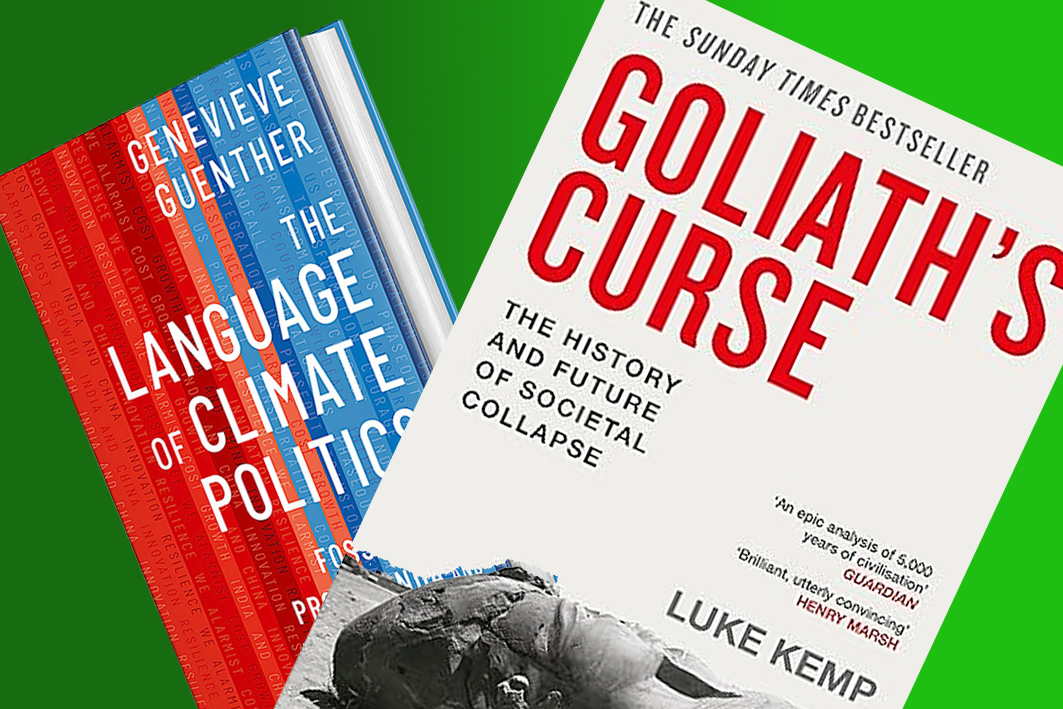
For this month’s column I’m indebted to the work of Luke Kemp’s book Goliath’s Curse, subtitled ‘The History and Future of Societal Collapse’, and another important work, The Language of Climate Politics by Genevieve Guenther – subtitled ‘Fossil-Fuel Propaganda and How to Fight it’.
The two books are linked, despite what at first seems like very disparate subject matter. Their commonality is information quagmire that has become social media and what to believe or not to believe on-line, and how that in turn, is fuelling not just a rift in social cohesion, but also fuelling an ever growing acceleration in global warming through the energy usage of AI data centres worldwide including Australia, which is going through something of its own gold rush at the moment.
The good citizens of the Northern Rivers might, with a wry smile, laugh off such a seemingly esoteric subject, given the generally poor nature of internet reception in the area. The irony of Elon Musk’s Starlink coming to the rescue is not lost upon them either. Musk’s X (nee Twitter) and Grok are not known for their impartiality and veracity.
AI itself is an industry that is already prone to hyperbole and exaggeration, so it’s wise to take some claims with a grain of salt, but its relentless demand for energy is not one of them and is supercharging our existing global climate crisis.
One search on Google uses as much electricity as is required to power a lightbulb for two minutes. One query to ChatGPT is 25 times more costly. You could light a lightbulb for 50 minutes. Kemp writes that if all our digital technology was a single country, it would be the third highest consumer of electricity behind the US and China.
And yes, while AI might help in the progress of some areas of science, it’s hard to see this outbalancing its uses as an enabler of technofascism that Silicon Valley is supercharging. AI accelerates the creation of global catastrophic risk, arms races and military operations, and allows more and more data for mass surveillance while at the same time guzzling huge amounts of power and water.
Let’s bring this back to the state of NSW. Australia is among the top regions in the world for data centre developments, and NSW, particularly Sydney, sits in the middle. This looming overdevelopment isn’t the only thing eroding the achievement of climate goals, the massive expansion of coal mines comes to the fore, but this is not helped by national data from the Clean Energy Regulator showing that the total emissions from data centre operators have doubled over the past four years.
Ketan Joshi, an author and energy analyst, notes that Australia’s data centre lobby group is stumbling in its dance to avoid real regulation. Data Centres Australia is framing their narrative that AI data centres are somehow part of the energy transition, signing power purchases with renewable energy developers. Not so, says Joshi.
While a coalition of environmental and advocacy groups earlier this month called for mandatory 100% non-fossil fuel energy procurement for all new data centre projects, Data Centres Australia shot back, saying it does not need to be compelled to act, even though it says it is committed to net zero by 2030 targets.
In other words, big tech has to eat up billions of dollars’ worth of clean tech just to be neutral, and this is as good as it gets!
The industry itself is defining its data centres as “critical infrastructure” – something akin to a hospital or a dam. That doesn’t take into account the growing global scream of discontent about AI generative slop and deep fakes, and how it enables Techno Fascism and Enshittification of social media platforms.
As the ABC’s Alan Kohler recently said, “Social media is dead”. You don’t know what to trust on it, hence it has no real value. He had the experience of being the subject of a completely fake interview online where the head of the Commonwealth Bank Matt Comyn walked out on him during a 7:30 interview. It never happened.
This brings me to Guenther’s The Language of Climate Politics. Fossil fuel ideology is rampant throughout the internet, and especially on platforms such as X and Facebook where it contributes to its own echo chamber of a conspiratorial world view where science and facts are hijacked and selectively cherry-picked, to present an argument that the continued burning of fossil fuels somehow sits comfortably within the sphere of techno optimism.
Those who say that global warming is a subject of physics and engineering are banished from debate as being alarmist. Never mind the fact that, with truly staggering speed, the planet has revealed that the climate system will break down in catastrophic ways at much lower levels of global warming than once predicted.
The Northern Rivers is one of the most fire-prone and flood-prone parts of a continent that already holds the title for having the planet’s most variable weather. Climate breakdown will only supercharge this trend. Yet, and especially but not exclusively from the right of politics, we hear the term ‘resilience’.
Resilience misprizes the climate crisis, implying that the harms of global heating will not include overall climate breakdown but only discrete extreme weather events. It’s not just AI slop on social media that plays out on this one.
Mainstream media and especially the Murdoch empire are guilty of the latter, with the Black Summer bushfires of 2019-2020 and the devastating floods of 2022 framed as part of the narrative that there have always been floods and fires in Australia. Sky News After Dark was a regular contributor to this Dorothy Mackellar view of the climate.
Guenther’s book is much more than what can possibly be written in a monthly column, but she says that to look at climate change and not look away is to accept the reality of an epochal struggle than none of us would have chosen to participate in, but this is what everyone is facing.
Phasing out fossil fuels and remaking the world economy also includes the regulation of AI data centres. The NSW Government is rushing headlong into approving them without yet putting into place plans for how their water and energy is to be used, let alone priced.
Think about it at home next time when the screen is on. The pixels too are when the personal is political.