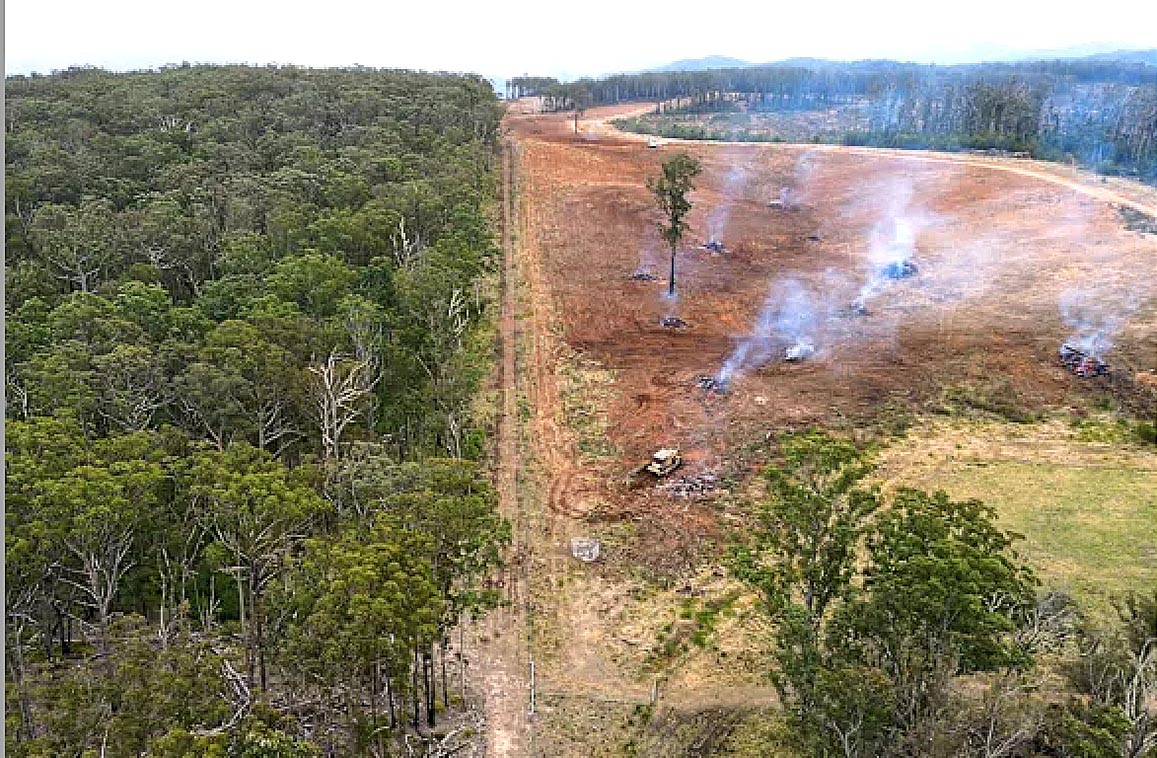
It’s easy to think of rampant land clearing as something that happened long ago – chainsaws and bulldozers carving up the landscape in another era. But the truth is far more confronting.
Research estimates that 29 million hectares of forests and woodlands that existed in NSW before 1750 have been destroyed – a staggering 54% of the state’s original forest cover gone.
New findings released this year by the Wentworth Group of Concerned Scientists reveal that between 2010 and 2023:
- More than 670,000 hectares of native vegetation was cleared in NSW;
- More than 33,000 hectares of riparian areas were cleared across NSW;
- More than 700 species listed as threatened or migratory under national environment law, theEnvironment Protection and Biodiversity Conservation Act 1999, are likely to have occurred in the areas now cleared;
- For at least 12 threatened species, more than 5% of their total mapped NSW habitat is likely to have been destroyed.
These aren’t abstract numbers. They represent ecosystems unravelling – and with them, the future of species that depend on them.
Data from the Statewide Landcover and Trees Study (SLAT) consistently shows that agriculture is the primary driver of canopy loss in NSW, with livestock grazing responsible for around half of that clearing.
That means millions of trees gone, along with the ecological communities, biodiversity, and riparian systems they support.
At the same time, beef production contributes significantly to climate change, accounting for nearly one third of Australia’s reportable methane emissions through enteric fermentation and manure.
More cleared land. More cattle. Fewer trees. Hardly sounds like a nature positive. Becoming a vegetarian is looking good!
At the intersection of land use and conservation sits the Environment Protection and Biodiversity Conservation Act 1999 – Australia’s key piece of national environmental legislation. Recent reforms have sharpened its reach.
Since 1st December 2025, clearing vegetation that is at least 15 years old – where it involves a matter of national environmental significance – is now a strict liability offence.
In plain terms: not knowing the law, or misunderstanding it, is no defence.
For example, if clearing has a real chance of significantly impacting an endangered species like the koala, including reducing habitat or fragmenting populations, a federal referral is required.
But here’s the problem: many landholders don’t know this.
Some report being told by State agencies that no further approvals are needed – advice that can be incomplete or misleading when federal obligations still apply.
Even when breaches occur, enforcement is often light-touch – education, warning letters, or negotiated outcomes – with prosecution rare.
While reforming the law is an improvement, laws alone don’t protect forests.
Without clear, consistent guidance and proactive outreach, well-meaning landholders can find themselves on the wrong side of complex regulations – and ecosystems continue to be lost in the process.
The Albanese Government can update legislation and refresh departmental websites, but expecting compliance through osmosis is not a strategy.
This is ultimately a question of priorities. Do we continue clearing land for short-term gain, while pushing species closer to extinction and weakening the systems that sustain us?
Or do we recognise that forests are not just scenery – they are infrastructure:
filtering water, stabilising soils, storing carbon, and sustaining life.
Real protection will require more than policy reform. It demands collaboration across all levels of government, clear communication with landholders, and a genuine commitment to ending avoidable habitat destruction.
Because once the trees are gone, they are not easily replaced. And neither are the species that depend on them. We must avoid the path to extinction.
The choice is still ours – but the window to act is narrowing.
KEG will be showing the film ‘Run for Country’, with guest speakers on Wednesday 20th May at 12.30pm at KMI Supper Room. It is a powerful documentary that tells the story of communities standing together to protect one of Australia’s most significant inland forests – the Pilliga – and the devastating impact coal seam gas has and will continue to have on Gomeroi Country if the Narrabri Gas Project goes ahead.