
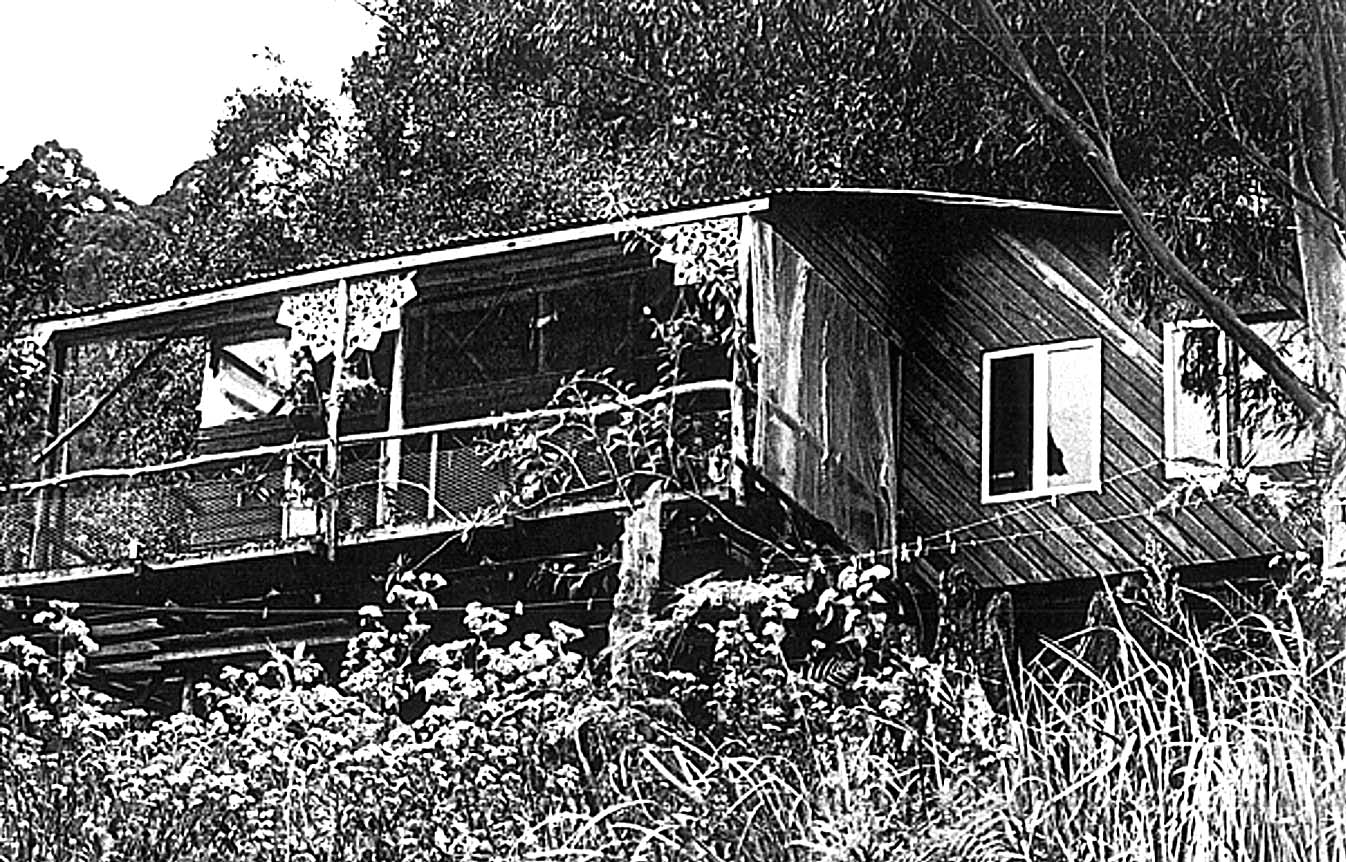
Immediately after the rainforest protests started at Terania Creek, another level of government decided to intervene in the lives of the new settlers in the Rainbow Region of NSW.
Even during the Terania Creek blockade, Lismore City Council tried to argue that Hugh and Nan Nicholson were operating an illegal campground by allowing protestors to stay on their land.
This failed because the Nicholsons were not charging the campers and could simply say they were hosting a large number of guests. But the houses built illegally at Bodhi Farm and the Tuntable Falls community were another matter.
Multiple Occupancy property ownership was at that time illegal. Land co-operatives were also unknown – Tuntable Falls was the first in the country. For many new settlers in the Nimbin area, houses were built as they were needed and few people paid attention to council building or zoning rules.
In late 1979, the Lismore Council suddenly decided to declare these houses illegal and demand that they be demolished.
It seems to me that the local council had turned a blind eye to the illegal building carried out by new settlers, possibly secretly admiring our pioneer spirit which was just like their grandfathers when the North Coast was first settled, and furthermore, the houses were out of sight of most of the area’s inhabitants, allowing the council to turn a blind eye.
But, just a few weeks into the Terania blockade, the Council realised that we weren’t good for business as usual and retaliated. One day the council building inspector showed up at Bodhi Farm and slapped demolition orders on all 15 of our houses.
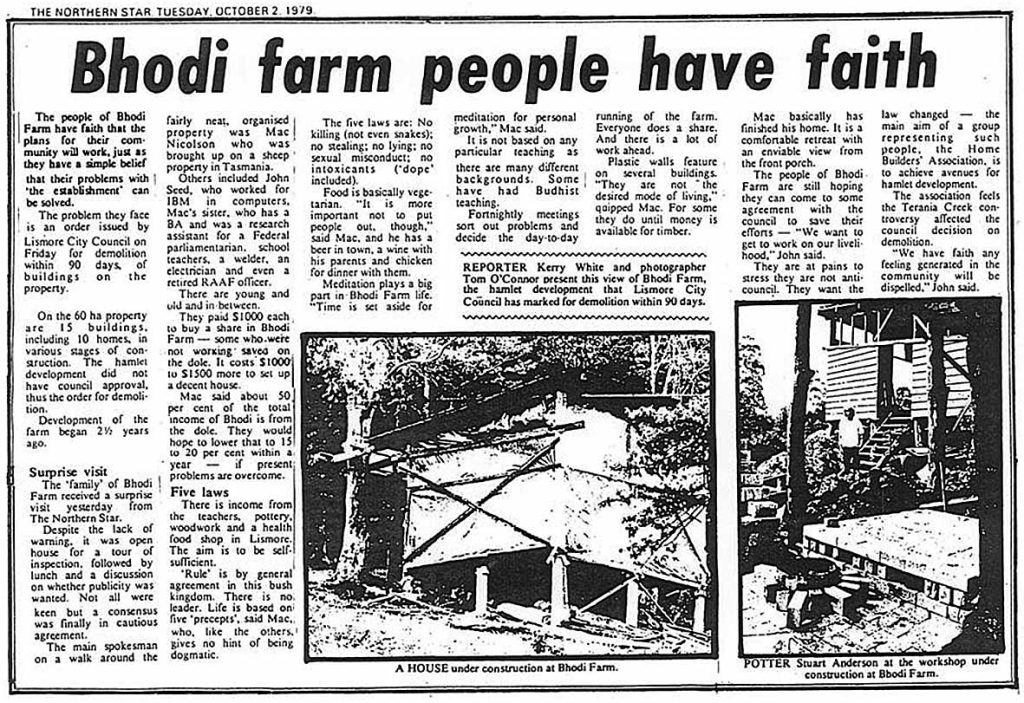
The local councillors were just rednecks as far as the eye could see. Demolition orders were also placed on all the buildings at Tuntable Falls and anywhere else that Terania Creek activists were living within the council’s jurisdiction.
Having picked up a few media skills in the forest campaign, we all signed up on the Housing Commission waiting list – if they demolished our houses we would seek public housing – and invited the press to visit and inspect our gorgeous hand-made homes which then appeared on the front page with lots of cute kiddies and hippies working laboriously in our vegie gardens.
We were certainly helped by the fact that the Council was associated with the Country Party. The local member, Doug Anthony was leader of the Country Party, the most right-wing major party, ancestor of the Nationals, and this issue gave the Labor Party an opportunity to rub their nose in it.
A hamlet development seminar was held, followed by the announcement of a draft law allowing multiple occupancy.
Bodhi Farm was zoned for multiple occupancy on 28th February 1980, less than six months after the council placed demolition orders on the farm’s dwellings.
But the story did not end there for John and Greta Seed. Lismore Council wanted to re-assert their authority, and in mid-1983 they sent the building inspector in again. The houses had a right to exist according to the new zoning laws, but did they meet Ordinance 70 (the building code)?
The Council was in a delicate position. They wanted to re-assert their authority but, having seen us victorious in the forests, in zoning and in home births (a story for another time), the building inspector clearly had instructions not to push too hard; he was only to ask for changes that were easy to comply with: an extra joist or bearer, add a verandah railing, things like that.
Our house was built up against the forest, with the side facing the forest open, the wall deliberately missing to minimise the separation, hard to tell where the forest ended and our habitation began, the house as an organic part of the forest.
My mum, Judy Cassab described it as having acquired “an Indonesian personality: the open side, where the entrance is, looks like a botanical garden. Walkingstick palms, creepers, sunlight. Bamboo walls, passionfruit ripening. The see-saw in the living room looks like a modern sculpture and the plate glass window is covered with a huge mandala.”
But this design was in breach of Ordinance 70, which required buildings to have four walls, and the building inspector was adamant that a fourth wall had to be built. We refused to comply, and a second demolition order was issued.
Murray Wilcox QC, top silk, was president of the Australian Conservation Foundation and he knew us from the rainforest campaign. When he heard of our plight he offered to defend our house for just Legal Aid, a tiny fraction of the fee he would normally command, and we won in the Land and Environment Court.
The story continues in this 4-minute video clip: https://drive.google.com/file/d/143ebSfn8aTFBDjUFLLwDeyKl5JwxR1TG/view