
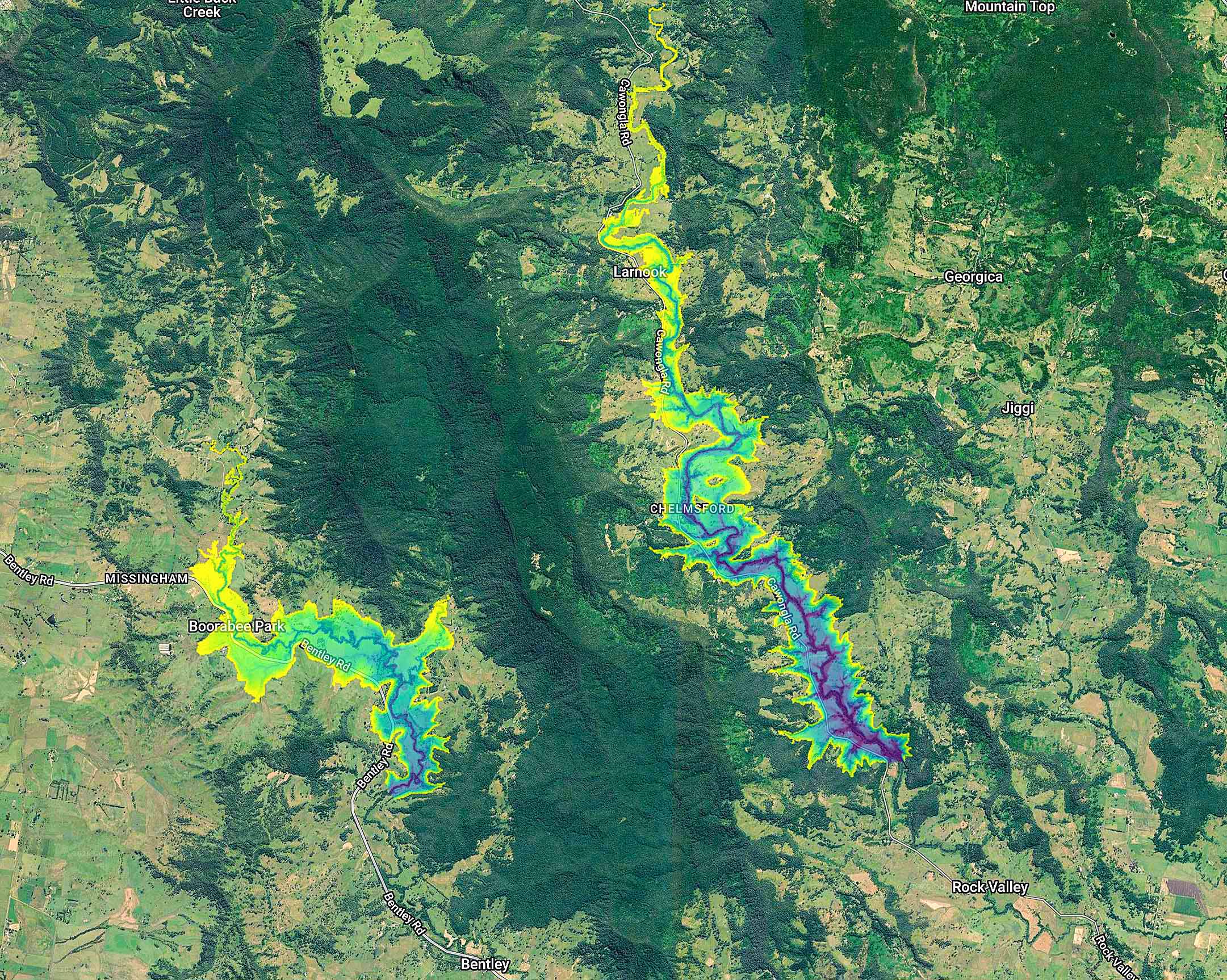
Since its release, the final CSIRO report into flood mitigation scenarios has been received with strong criticism across the flood-affected communities in the Northern Rivers.
Between 20th and 23rd July, five community “drop in sessions” about the report were held in Kyogle, Casino, Lismore, Ballina and Woodburn, to ask questions of CSIRO team leader, Dr Jai Vaze, Pat Burford from the National Emergency Management Authority (NEMA) and flood engineer Will Prentice from the NSW Reconstruction Authority (RA).
Attendance figures were 100 in Kyogle, 60 in Casino, 580 in Lismore, 150 in Ballina and 180 in Woodburn, 1070 in all. At these meetings, people living where the 10 detention basins are proposed overwhelmingly voiced concerns about the preferred modelling, for a range of reasons.
Concerns raised
Predominant among these were the effects of the full detention basins on the estimated 900 properties, productive farmland, the environment and landscape, communities and infrastructure such as roads, bridges and access, and public safety.
In response to questions about these, the answers were uniformly that these issues would be considered in the newly-announced $3 million feasibility study, due to begin this month. The scope of the RA co-ordinated study was yet to be determined.
Not considered in the modelling were clearing and opening up creeks, dredging the rivers, increasing the height of the Lismore levee, building additional pumping stations, a pipe or channel from Lismore to the ocean, nature-based solutions, or relocation strategies.
In response to questions about these options, Dr Vaze responded by saying either that they would not work, or did not make sense, or the numbers did not stack up, or they have not been shown to work, or were opposed by environmentalists, or were not in the study’s terms of reference.
Regarding nature-based solutions, a member of Richmond Landcare told the Lismore meeting that it was undertaking a pilot nature-based solutions project with the involvement of Griffith University, which involved depth-loggers to assess its effectiveness, which appeared positive.
Dr Vaze’s answer was that he had had discussions with the project team and that structural strategies and nature-based solutions “go hand in hand”.
Other enquiries, including whether there were any global precedents for detention basins where people live, the answer was no, with Dr Vaze saying detention initiatives had resulted in successes and failures across the world, and this project would be the first time on this scale in Australia.
Legislative changes
Attention was drawn by a speaker to the NSW Water Management Amendment (Easements for Inundation) Act 2026, assented on 18th May, which was seen as alarming by many.
In the Act, a new section of the Water Management Act 2000 allows for easements to be created in favour of Water NSW for “inundation for environmental purposes”, with Effect (4): “No compensation is payable to a person in connection with a transfer order except to the extent, if any, to which the order provides.”
The new Act also amends the Water NSW Act 2014 with a new definition: Section 3(1) “Inundate, in relation to land, includes (a) inundate private land, and (b) move water to or across land, including private land”, and Section 37(3):
“(4) No compensation is payable under this section for damage resulting from the inundation of land as a consequence of anything done, or omitted to be done, by Water NSW.”
A repeated complaint was about the lack of engagement of upstream communities in the study’s processes, including community meetings and meeting notifications, and provision of information including maps.
A show of hands was called for by a member of the audience at the Lismore meeting; only seven people raised their hands in favour of the CSIRO model.