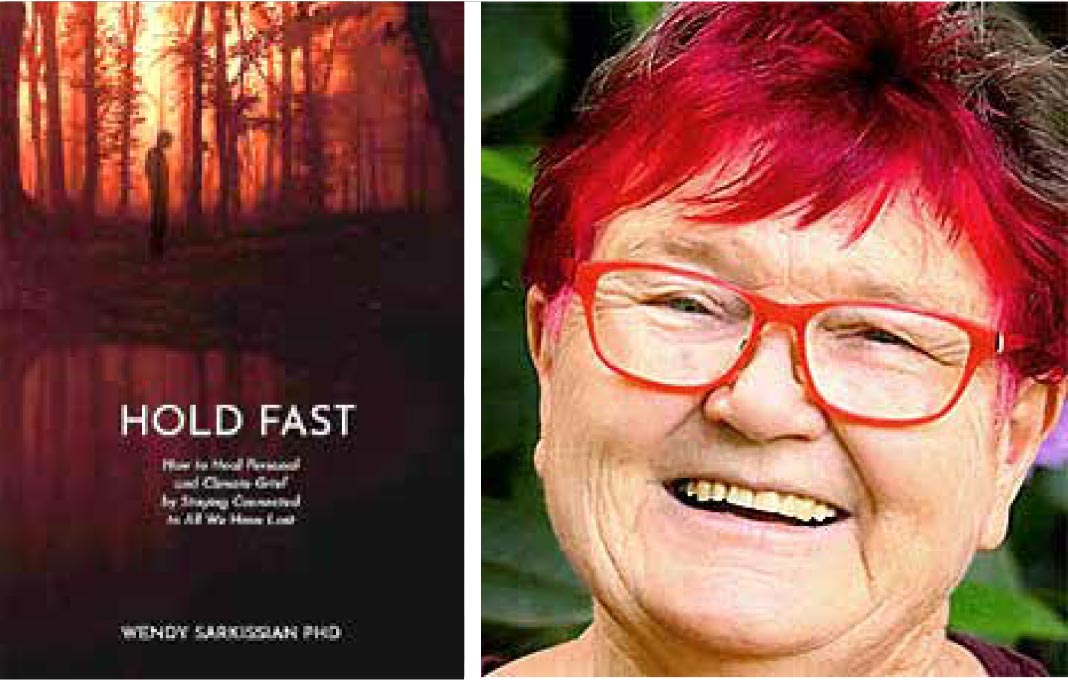
Dr. Wendy Sarkissian’s Hold Fast: Navigating Personal and Climate Grief with a Reconciled Heart is a work of extraordinary courage and intellectual rigor. It is rare to find a book that so seamlessly integrates the “inside voice” of private mourning with the “outside voice” of global activism.
As someone whose life has been consecrated to the service of the Earth, I recognise in Wendy a fellow traveller who has finally named the “thing itself”: the Reconciled Ecological Self.
The book opens with a terrifying rupture: the 2016 car crash in rural Australia that claimed the life of her soulmate, Karl. Wendy’s description of “midwifing” Karl’s passing in the dark waters of the Tweed River is one of the most spiritually profound accounts of death I have ever read.
In the aftermath, she did not seek to “get over” her loss; instead, she explored “new languages of love that bridge the seen and the unseen,” influenced by the teachings of Rudolf Steiner.
Part 2 of the book transforms this personal odyssey into a practical framework for all mourners. Wendy identifies Four Stopping Places (or Atchin Tan in the Romani tradition) where we can integrate the lessons of grief: Acceptance, Gratitude, Forgiveness and Service.
Her “survivor mission” – a tenacious campaign for road safety reform – illustrates how Service to Others becomes the “sacred work of sorrow”. She argues that action is a vital component of healing, a sentiment that resonates deeply with my own activist roots.
However, it is in Part 3 that the book achieves its most significant philosophical breakthrough. Wendy turns her “widened lens” toward the planetary crisis, arguing that personal grief and climate grief arise from the same wound – our inability to “hold fast to what we love”.
She situates her work firmly within the “Acceptance perspective”, refusing false reassurances or “naïve optimism”. Drawing on the science of 2026, she acknowledges that critical tipping points have likely been passed.
In this “long emergency,” Wendy offers the Reconciled Ecological Self (RES) as our new “compass”. This concept is a brilliant synthesis of Arne Næss’s “Ecological Self” and Alan Wolfelt’s “Reconciled Self”. While Næss taught us to widen our circle of caring to include all life, Wolfelt taught us to carry loss forward without being destroyed by it. The RES is the self that emerges when we fully accept ecological unravelling while refusing to sever ourselves from the Earth.
Wendy’s use of the “ecotone” metaphor to describe the RES is a stroke of genius. Just as a creek-edge is a zone of “coexistence and invention” between a forest and a woodland, the RES is a “living threshold” where grief and renewal mingle. She writes, “to be reconciled is to acknowledge that Earth… will not return to its former state. Yet this Self still chooses to live with integrity”. This is the Active Hope pioneered by Joanna Macy, who Wendy honors as a foundational teacher.
The book does not shy away from the brutal political realities of 2026, documenting “annus horribilis” rollbacks in the US and “delay and downplay” tactics in the UK and Canada. Wendy’s own “climate shame” regarding her decades of international flying is a powerful act of transparency that invites the reader into the Stopping Place of Forgiveness. She reminds us that “blame, when it calcifies, freezes the flow of energy we need for repair”.
One of the most moving aspects of Hold Fast is its intergenerational focus. Wendy speaks to the “eco-grief” of young people who feel “locked out of home” by an uninhabitable planet. She offers them – and all of us – the “refuge” of a community that can “honor our pain for the world” as a proof of love. The inclusion of practical “Heartfelt Rituals,” like the Truth Mandala and the Council of All Beings, provides tangible ways for groups to move through the “spiral” of connection and action.
Ultimately, Hold Fast is the testimony of a “Guardian of Sacred Remembering”. Wendy Sarkissian has taken the “bone-cold truth” of our time and transformed it into the “only thing more durable than hope: connection”. She writes as a woman who has been “pummeled by grief” yet “released to love again”. Her voice is playful, anecdotal and seasoned:the voice of an 83-year-old elder who “speaks plainly about what humans have done to the Earth” while sharing the “steadiness a long life can offer”.
This book is part of the Twilight River Trilogy, and it stands as a magisterial conclusion to her lifetime’s work. It is a “manual for our times” that helps us “belong in a world being remade by loss”. Perhaps it is even the ‘Manual for Living with Defeat’ that Leonard Cohen would have written had his muse allowed (Going Home, 2012)
By the end of these pages, the reader understands that “holding fast” is not about clinging to a dying past, but about staying aligned with purpose in the midst of danger.
I believe that the Reconciled Ecological Self is one of the most important psychological and ethical concepts to emerge in this century. Dr. Sarkissian has given us the grammar we need to survive the Great Unraveling with our hearts awake and our hands extended. Hold Fast is an incomparable gift to a grieving world, reminding us that even in endings, to love is never futile. As she concludes, “connection has been holding us fast all along”. Amen to that.