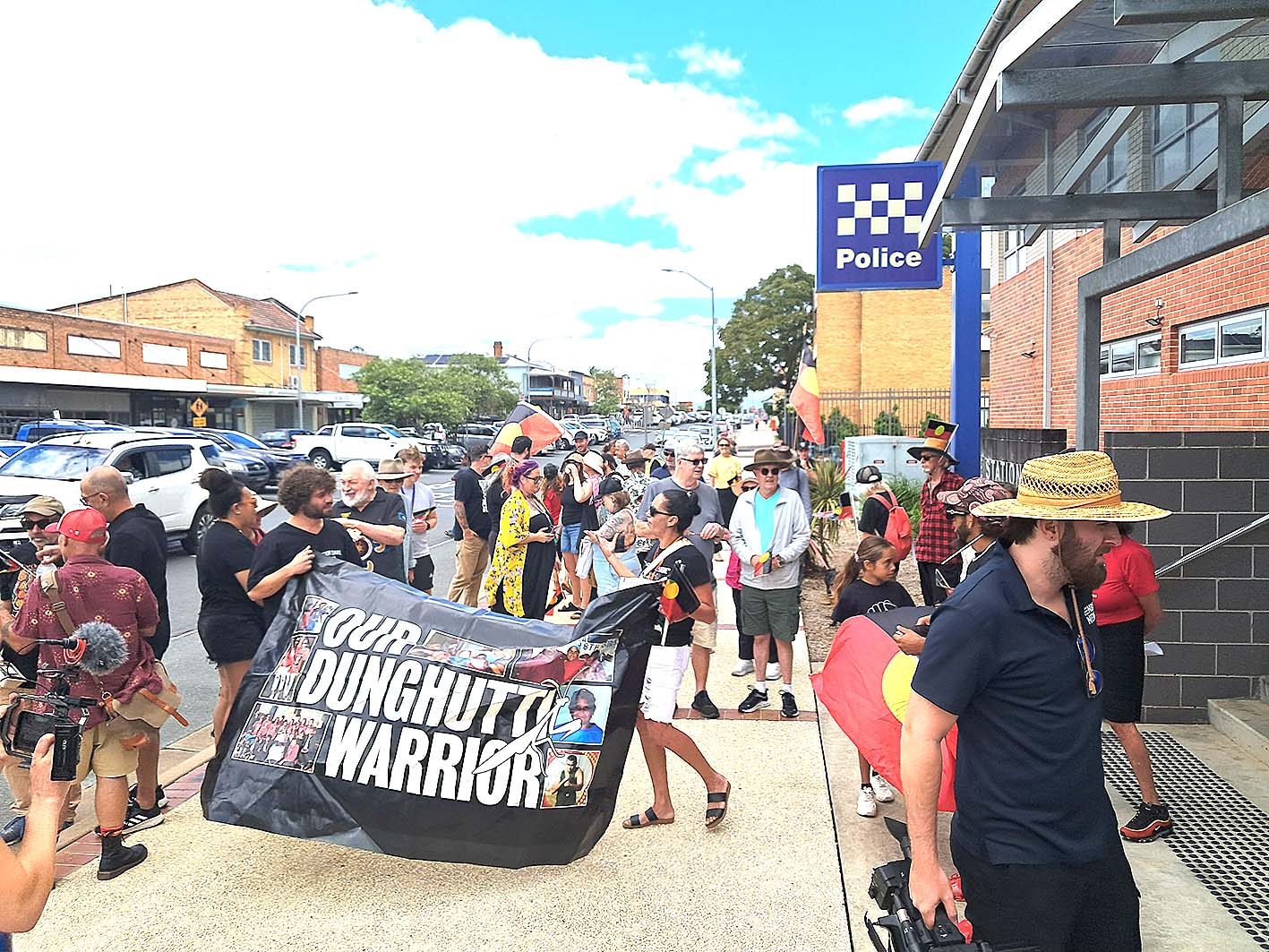
Around 50 people walked from the Kempsey police station, Dunghutti country, through town to the Riverside Park on Monday 29th December for the tenth anniversary of the death of David Joseph Dungay in Long Bay Correctional Centre.
He died after the Correctional Response Team came into his cell to move him, just weeks before his release, and you can hear him on the video calling out, “I can’t breathe.”
In 1991, the Royal Commission into Indigenous Deaths in Custody, which was established in 1987, came up with 339 recommendations. The commission investigated 99 Aboriginal deaths in custody in the time from 1980 to 1989.
It cost $40 million dollars which is around $95 million dollars in these days’ money. To this day the government has not put all recommendations into practice.
David Joseph Dungay was diagnosed with asthma and diabetes in his youth and had some mental health issues. He was eating a rice cracker in his cell when the medical team raised the alarm.
The Correctional Response Team wanted to move him into a different cell with an installed video camera. He was injected with a sedative and he called out 12 times that he can’t breathe. He died minutes later and all attempts to resuscitate him didn’t work. He died from a cardiac arrhythmia.
His family fought for a coronial inquest and that started in July 2018, two and a half years later. Testifying there, the Commissioner of Corrective Services said that it was a misconception that a restrained person who can talk would be able to breathe. The inquest was running late and so not all witnesses could be heard.
A new inquest hearing started in March 2019 where the psychiatric registrar said regarding staff concerns referring to Dungay’s blood sugar levels didn’t call for an immediate intervention and a cell transfer. The doctor on duty that day told the court that he could have done better and that he had never performed CPR before that day.
In November 2019 the coroner found none of the guards involved should face disciplinary action and their conduct “was limited by systemic deficiencies in training”.
Leetona Dungay said after the findings were announced that justice had not be served and that the family would try to prosecute the guards. In June 2021 she said that she would lodge a complaint with the UN Human Rights Committee with the hope that that would encourage all governments to implement the 1991 Royal Commission recommendations.
She has the assistance of human rights lawyer Jennifer Robinson, who worked for Julian Assange, as well as George Newhouse.
As Arthur Bain, the Greens councillor of Kempsey, said in front of the police station, “In 2024/25 we broke the record for aboriginal deaths in custody. The system is broken and we can be a voice for change and we can draw attention to this crime that is happening every day to First Nation people.”
Thirty-three Aboriginal and Torres Strait Islander people died in custody last year, 26 in prison (highest ever recorded), six in police custody and one in youth detention. In 1991, 14% of inmates were indigenous, now it’s 39%.
As of the 2021 Census, Aboriginal and Torres Strait Islanders made up 3.8% of Australia’s total population.
Aunty Leetona, the mother of David Dungay, said, “My son should be still alive. We all are wounded. Black lives matter!”
Councillor Arthur Bain said at the end of the march in Riverside Park, “The coroner said he died under controversial circumstances. It was murder… The first step is to stop putting kids in gaol!
“A 14-year old isn’t mature enough to go on social media, but they are old enough to be locked in a cage with a spithood. Stop jailing kids.”
It’s on us to speak up for urgent change, necessary training and the implementation of all the recommendations of 1991 Royal Commission.