The Minns Labor government has released its response to the recommendations from the 2024 Drug Summit. While many of the recommendations have been supported either fully or in principle, concerns have emerged about several key reforms the government has chosen to ignore or delay.
Former magistrate and drug law reform advocate David Heilpern expressed his dismay at the government’s position, describing it as a “betrayal” and a “massive defeat for the drug reform movement.”
The Drug Summit involved four days of forums attended by more than 700 participants across Sydney, Griffith and Lismore. Attendees represented a broad cross-section of stakeholders including health experts, police, service providers, community members and people with lived or living experience. In addition, 3,669 written submissions were received through an online survey.
The final report, authored by co-chairs Carmel Tebbutt and John Brogden, was handed to the government in April. It contained 56 recommendations, with a strong emphasis on a coordinated, whole-of-government approach focused on harm minimisation.
Since the summit, several agencies have begun implementing reforms, including changes to social housing policy, longer-term grants to improve job security for service providers, education campaigns targeted at young people, and a 12-month drug-checking trial at festivals.
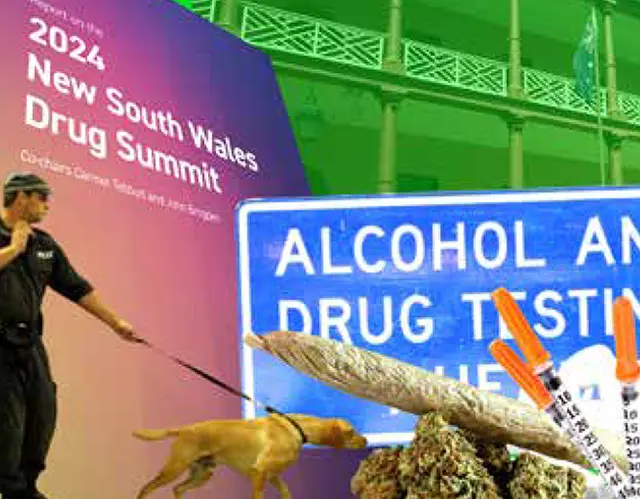
However, in its announcement on 28 October, the government confirmed it would continue the use of sniffer dogs and strip searches at music festivals — a practice the report explicitly recommended should cease.
This decision has drawn renewed scrutiny following a landmark case in which Sydney woman Raya Meredith was awarded $93,000 in damages after a “humiliating” and unlawful strip search at the 2018 Splendour in the Grass festival. A separate class action involving 3,000 people strip-searched at festivals between 2016 and 2022 is also before the court. If successful, the government may face a further $150 million in compensation payouts.
Beyond the legal risks, Mr Heilpern raised serious concerns about the potential for fatal overdoses, noting that festivalgoers may “front-load” drugs to avoid detection or possession charges.
The report also recommended legislating a medical defence for drivers using legally prescribed cannabis. The government has instead opted for another investigation, to be carried out by a working group of experts. While this group will eventually provide recommendations, there has been no commitment to act on them or clarity about how the group will be formed. Tasmania remains the only state that allows prescription cannabis patients to legally drive with THC in their system, and there is no evidence suggesting this has compromised road safety.
“There is a glimmer of hope,” Mr Heilpern said, though he argued that international and Tasmanian examples already provide sufficient evidence to move forward without further delay.
Another major recommendation that appears to have been overlooked is the establishment of additional safe injecting rooms across the state. NSW currently has just one supervised injecting facility, located in Kings Cross. The report recommended amending legislation to allow medically supervised injecting centres in metropolitan, regional, rural and remote areas.
While some reforms — particularly around drug-driving laws — may still progress, drug law reform advocates fear the government’s response signals a missed opportunity for more significant changes, including decriminalisation.