
The CSIRO has released its final report for the Northern Rivers Resilience Initiative (NRRI) on flood mitigation which used complex modelling to investigate the impact of water detention projects on river levels during flooding in the Richmond River catchment.
Utilising data from the 2008, 2017 and 2022 floods and information from Northern Rivers residents, the detailed hydrodynamic modelling focused on two bundles of mitigation strategies and how these interventions would have impacted water levels along the Richmond River during these historic events.
The first bundle represented a smaller number of interventions while the second bundle, which is preferred, included additional works across the catchment area.
While the modelling demonstrated that both bundles would help to reduce river levels during floods, CSIRO hydrologist and lead for the study, Dr Jai Vaze, while being generally optimistic, has conceded that the overall reduction in river levels would not necessarily prevent flooding.
Dr Vaze said, “While we might not be able to prevent a flood like 2022, with a co-ordinated approach we can reduce flood heights and impacts, which can help lessen damage and support future resilience for the community.”
Detention Basins
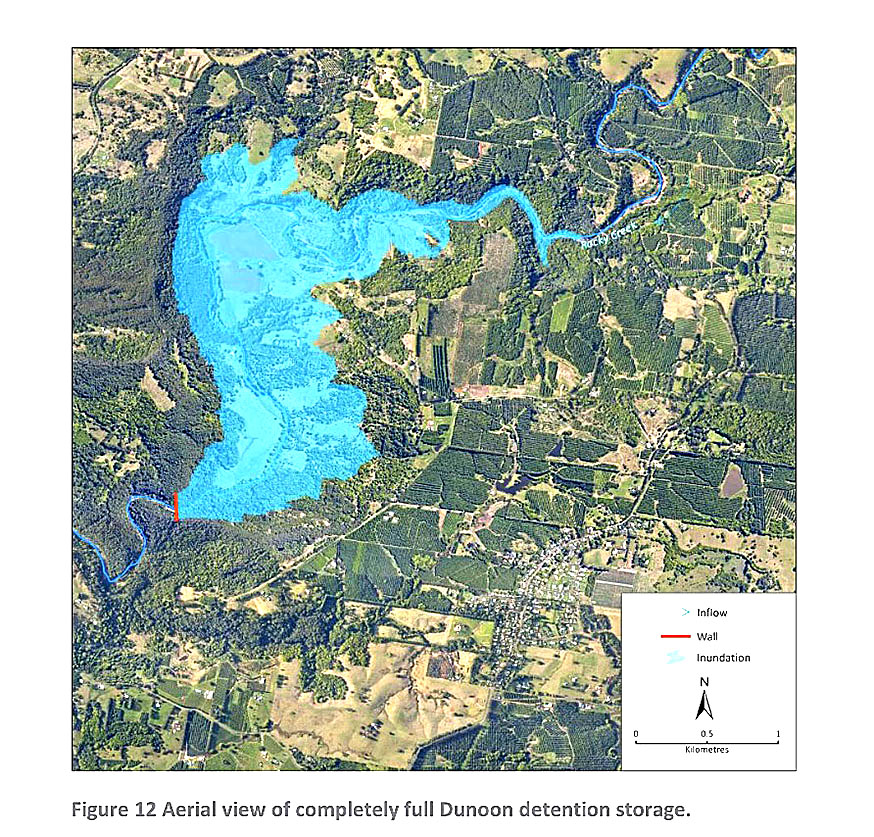
The scenario that achieved the greatest modelled reduction in flood levels (Bundle 2) includes 10 proposed retention basins across the upper Richmond catchment:
• Rock Valley – 94.3 GL
• Corndale – 91.3 GL
• Booyong – 82.8 GL
• Eden – 69.4 GL
• Goolmangar – 53.9 GL
• Dunoon – 43.0 GL
• Bentley – 40.7 GL
• Collins Valley – 39.5 GL
• Fawcetts – 39.2 GL
• Barlings – 11.3 GL
By comparison, Rocky Creek Dam holds 14 gigalitres.
NSW Greens MP and spokesperson for North Coast, Sue Higginson highlighted the shortcomings of the report and the modelling used, saying, “This project was commissioned and tasked with recommending hard-infrastructure like dams as flood mitigation – that’s why this report is only about pouring concrete in the upper catchment.
“Dams only offer false hope of flood mitigation, our community needs solutions and not just disinformation that will cause more harm.
“Now that the science is in this report, it’s time for Kevin Hogan and the Nationals to admit that floods will continue to hit the communities of the Richmond River and that their favourite solution of more dams will make the problem worse.”
In contrast, Federal Member for Page Kevin Hogan, who pushed for the CSIRO study while in government, welcomed the outcome and has advocated for the 10 proposed dams to be built.
He said, “Flood mitigation is the only strategy that will deliver long-term safety and certainty for our region. Recovery efforts alone will never solve the problem.
“Our community has waited more than three years for this work. We now need the state and federal Labor Governments to act on the recommendations to protect our region.
“The projected costing of the mitigation recommendations from the report will be about $2 billion. The 2022 disaster alone was a $15 billion event.
“This report cannot sit on a shelf gathering dust. The Labor state and federal governments must act on delivering recommendations that can take up to two metres off future floods.”
In a Facebook post, Lismore City Councillor Virginia Waters urged residents to take a closer look the report, in particular, the proposed dam locations and the potential ecological, cultural, agricultural and biodiversity impacts on those communities.
Drop-in sessions
The NRRI will provide opportunities during July for community members to speak directly with NEMA and CSIRO staff about the findings and recommendations in the final report.
• Kyogle: Monday 20th July, 9am at Kyogle Memorial Hall
• Casino: Tuesday 21st July, 3.30pm at Casino Community and Cultural Centre
• Lismore: Wednesday 22nd July 9-11am at Lismore Workers Club
• Ballina: Wednesday 22nd July, 3.30pm at Ballina Lighthouse and SLSC
• Woodburn: Thursday 23rd July, 9am at Woodburn Memorial Hall
The report makes clear further work is required to better understand the feasibility of the recommended measures, which will be supported by a further $3 million in combined funding by the Australian and NSW governments to deliver a feasibility study.
The study will assess the technical, environmental, economic and social feasibility of potential interventions, and help inform future investment decisions.