Our communities don’t want Hogan’s dams. That has been the message loud and clear since the release of the final CSIRO Richmond River catchment flood mitigation report on 30th June.
For an absurd proposal with so little social licence, how did we get here?
The floodwaters had barely receded from the most devastating flood in our history on 28th February 2022, and Federal Nationals MP [for Page] Kevin Hogan – never one to waste a good crisis – was out of the blocks swiftly proclaiming “For everyone who is against engineering solutions… the debate is over. We are doing engineering work for flood mitigation.” We were getting dams, like it or not.
The Morrison government then commissioned the CSIRO to develop a hydrological computer model of the Richmond catchment with a narrow remit to only consider hard-engineering flood mitigation measures.
Last year the CSIRO and the federal government’s National Emergency Management Agency (NEMA) ran a handful of very limited and deeply flawed tick-box community ‘consultations’ (which I have previously written about in the NGT) to decide what vaguely defined measures they would model.
Throughout this process, NEMA appeared very reluctant to publicly provide specific locations for the detention dams, let alone proactively consult the communities that would be affected.
As has been evident in meeting after meeting since the final report was released, most people under threat from these dams had no earlier knowledge of them. They were very angry the dams were being foisted upon them, seemingly a fait accompli.
Even now at the time of writing, we still have not been provided with the inundation maps for eight of the 10 proposed dams. Thankfully however, a hydrological expert in the community has stepped up to do this where the CSIRO has failed. See: https:// richmond-flood-maps.projects.earthengine.app/view/richmond-flood-maps
As I and others warned CSIRO lead scientist Jai Vaze in last year’s ‘consultations’, if he proceeded to model these detention dams without genuine community engagement and social licence his report would face a fierce community backlash when released – as indeed it has.
His team was also advised they needed to consider at least basic economic, geotechnical/engineering, environmental and cultural facts on the ground before choosing what to model.
Their failure to do so has resulted in theoretical proposals that are absurd and unworkable in the real world: a computer la-la land that has cost the public millions of dollars and years of work, false hope and delayed action.
But reality has now caught up, our communities are awake, they are angry and they are active. The few information sessions run by CSIRO/NEMA this July were very well attended. Attendees demanded (and got) a change of format to extended town hall style meetings where they could share their concerns together as a community rather than suffer the manifestly inadequate brief one-on-one ‘drop-in’ sessions first proposed.
Since then, upstream communities under threat from these dams including Rock Valley and communities around Kyogle, Nimbin and The Channon/Dunoon have organised their own local meetings with action groups now joined under the umbrella of Valleys United. See: https://www.facebook.com/p/Valleys-United-Protecting-our-Communities-from-Detention-Floods-61593512023994
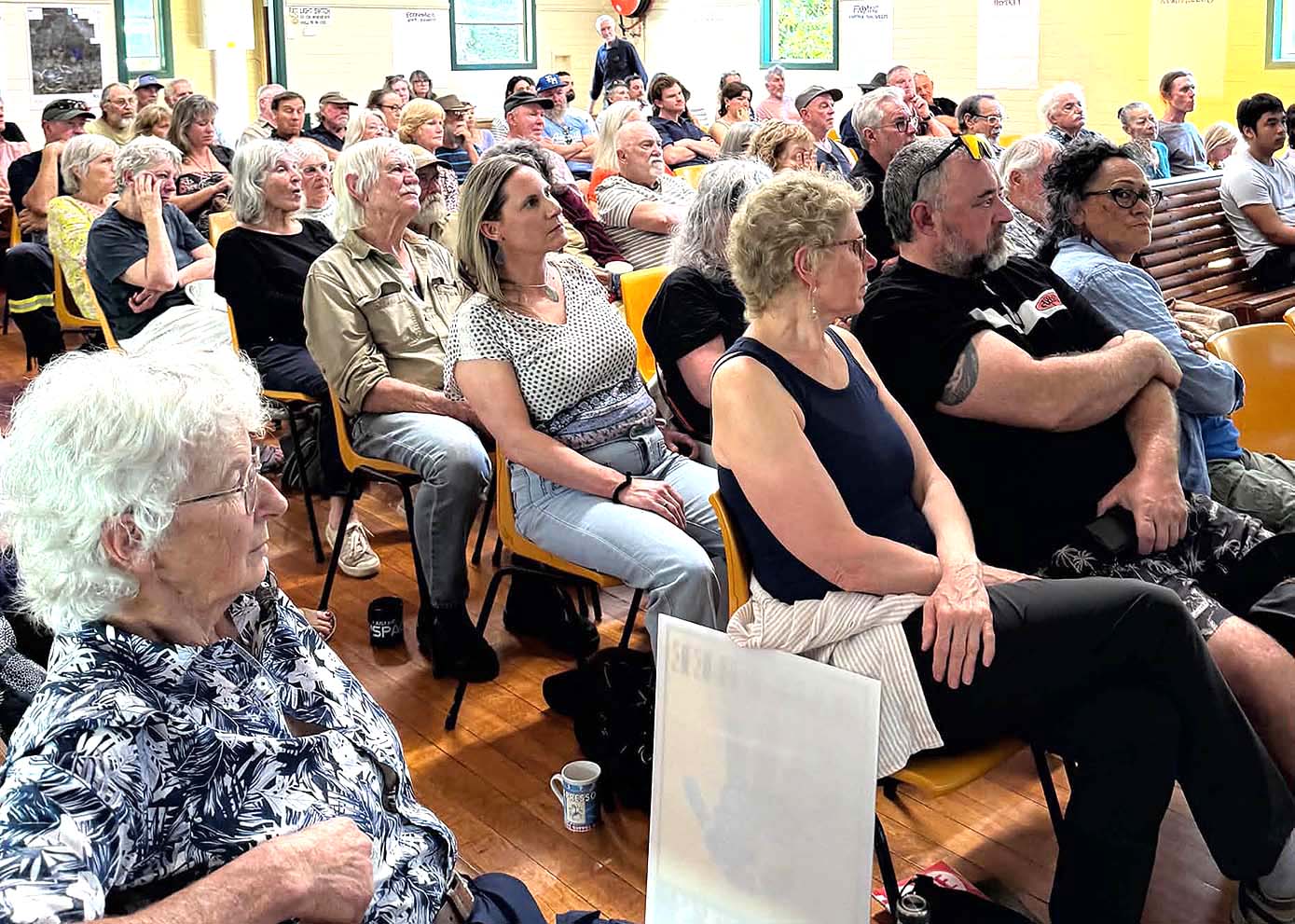
On Saturday 19th September I attended another of these meetings, this one organised by The Channon Resilience Hub. Speakers included civil engineer Steve Posselt, and local community leaders Annie Kia and Nan Nicholson.
The Channon Hall was packed and we heard again the same concerns expressed in other communities facing these dams.
These included the destruction of flooded properties and farms, prolonged isolation from flooded roads and landslips, the exorbitant cost of dam construction and on-going maintenance, the engineering and geotechnical absurdities of the modelled dams, the destruction of precious remnant Big Scrub rainforest and Widjabul-Wiabal sacred sites, just to name a few.
And in particular, the abject failure to properly consult with affected communities.
People in these communities are living under a cloud, stressed, fearful of losing their homes and farms, seeing property prices plummet, unable to invest or sell, their plans for the future on hold for years while they wait for the outcome of a ‘feasibility’ study
So far, the Greens are the only party standing with our communities against these destructive dams. These monsters are Federal National’s MP Kevin Hogan’s creation, yet state Labor MP Janelle Saffin has also stated the CSIRO dams report he instigated “gives us real hope”.
It doesn’t. It has been used to peddle false hope to those in Lismore who according
to the CSIRO model would still go under in another 2022 flood. It distracts from
the only guaranteed and very likely most economical way to keep people safe from flooding: moving off the floodplain (while also investing in nature-based solutions with all their co-benefits). And it proposes punishing upstream communities for the failure to do this.
So, whether it is for social, ethical, economic, geotechnical, engineering, environmental or cultural reasons, everyone already knows these dams can’t happen. Hogan’s dams are dead. And the sooner this is officially declared the better.
But if our current leaders won’t listen, then we can make sure they hear us loud and clear when we vote next year in the NSW state election.